yElixir Labs · A thin-film physicist's science content studio
Not science that just sounds right. We make science that works.
Science explainer videos, multilingual localization and computed visualizations, made by a physicist. Even the coater in Fig. 1 is not decoration: every time it lays down a layer, it recomputes the lens's reflectance and color with a thin-film interference model.
Fig. 1E-beam coater · reflective lens coatingPress for the next layer0 layers · 0.0 nm · R(550) 4.3%
Electron beam: on only while depositingLens and rotating holder: the lens shows its computed reflected colorFront dial: thickness of the current layer, 100 nm per turn
Build it yourself
Press a button or the figure to open the shutter and lay down the next layer. With the figure focused, Enter deposits and R puts in a new lens.
Layers
0 / 15bare glass
Total physical thickness
0.0nm
Reflectance at 550 nm
4.3%
Reflected color (sRGB)
#3a3a3a
Idle · deposition time at the assumed rates 0 min 00 s
What Fig. 1 computes
The colors and numbers in the figure and both charts below come from one model. High-index (H) and low-index (L) layers, each a quarter wave thick at 550 nm, are stacked in turn on the lens.
Optical monitor signalreflectance % · total thickness nm
Reflectance measured at 550 nm, plotted against the thickness deposited so far. The curve turns exactly when a layer reaches a quarter wave, which is why coaters with optical monitoring close the shutter at these turning points.
Current reflectance spectrumreflectance % · wavelength nm
Reflectance of the whole stack, computed from 380 to 780 nm. As H and L layers alternate, the reflection band around 550 nm grows taller and steeper, and the lens color follows the band.
Model and assumptions
Multilayer reflectance from the characteristic matrix method, at normal incidence, with no absorption or dispersion.
Glass n = 1.52, H n = 2.10 (taken as Ta₂O₅), L n = 1.46 (SiO₂). Layer thicknesses: H 65.5 nm, L 94.2 nm.
The lens color is the reflectance spectrum under D65 light, integrated with the CIE 1931 2° color-matching functions and converted to sRGB. The film grows on the underside, facing the source, but a lossless film reflects the same from either side, so the lens seen from above is painted that color. Reflection from the uncoated top surface is left out.
Assumed deposition rates: Ta₂O₅ 0.3 nm/s, SiO₂ 0.8 nm/s. The animation plays 80× faster.
Uncoated glass reflects 4.3% at 550 nm; all 15 layers bring it to 99.2%. Substrate rotation, the shutter and the electron beam are shown as motion only; film-thickness uniformity is not computed.
What we do
Three kinds of work. Whichever it is, a physicist checks every claim and number before it reaches the screen.
Fig. 2Camera slider
01
Science explainer videos
Explainer videos in which a physicist has reviewed every claim in the script. Each week, one long-form video and five Shorts on the same topic come out together as a series.
Production pipeline: gpt-image keyframesGrok motionElevenLabs narrationPython compositing
Published videos · as of 16 October 2026KO long-form 3 · Shorts 15 / EN long-form 3 · Shorts 14 / JA long-form 3 · Shorts 15
Fig. 3Three-channel mixer
02
Multilingual localization
The same story comes out in Korean, English and Japanese at the same time. Three channels have run on the same schedule since 28 September 2026, and Chinese is in preparation.
Total channel views · as of 16 October 2026KO 13,387 · JA 5,798 · EN 1,213
Fig. 4Pen plotter15-layer reflectance spectrum · up to 640 nm
03
Computed visualizations
Physical models turned into interactive visualizations and research software that run right in the browser. As in Fig. 1, the numbers and colors on screen come straight from the model. A browser-based thin-film designer is in development.
Published exampleMega Man X Bench · six AI models compared on one prompt
Recent work
Each topic becomes one long-form video and five Shorts, published in three languages. Below are the English long-form videos so far; press one to play it right here.
Week 1 · Water · long-form 11:44 · 5 Shorts
From a Cold Can to Rain: Where Does Water Appear?
Where does the water on a cold can come from? We follow invisible water vapor in the room as it turns to liquid on surfaces colder than the air's dew point, then connect it to white breath, fogged windows and floating clouds. Finally, we look at the two ways tiny cloud droplets become raindrops: by colliding and merging, or by growing as ice.
Week 2 · Heat · long-form 12:11 · 5 Shorts
Will an Open Fridge Cool the Room?
The air at an open fridge door feels cool, but will it cool the whole room? We separate heat from temperature and follow refrigerant through evaporation, compression, condensation and expansion. Cold-feeling metal, fans, outdoor AC units and winter heat pumps reveal different routes for heat.
From Sky to Soap Bubble: Where Does Color Come From?
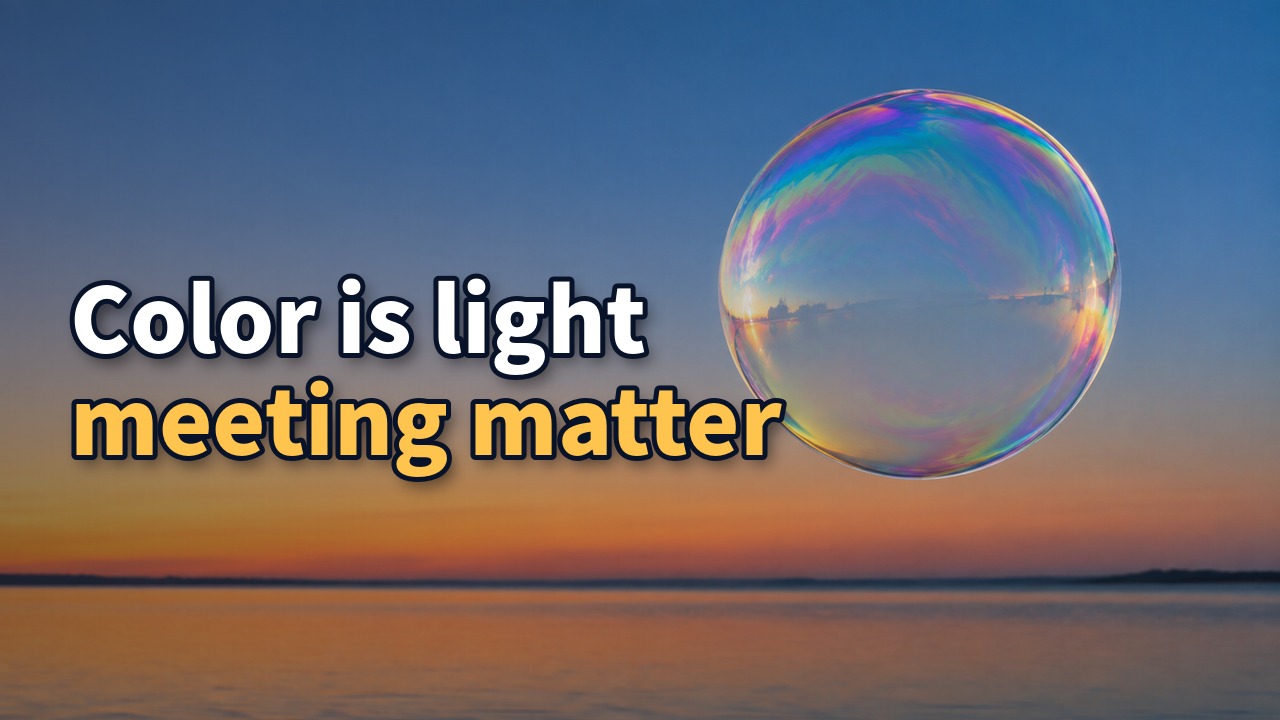
The sky is blue, sunsets are red, and a soap bubble with no dye in it shimmers with rainbow colors. We recreate a sky and a sunset in one tank of milky water, then visit Mars where sunsets turn blue, and find out why clouds are white, why a double rainbow is flipped, and why the top of a bubble turns black. Color is not painted on things; it is the way light meets matter.